
Introduction
The 2025 startup landscape looks very different from just a few years ago. With economic shifts, the explosion of AI tools, and a move toward lean, efficient business models, founders today face a new reality: you can build more with less — but competition is also fiercer than ever.
One question keeps coming up for new entrepreneurs:
Should you bootstrap or raise venture capital?
Both paths remain popular, but the right choice depends on your goals, industry, and the realities of building in 2025. Here’s a complete breakdown to help you decide.
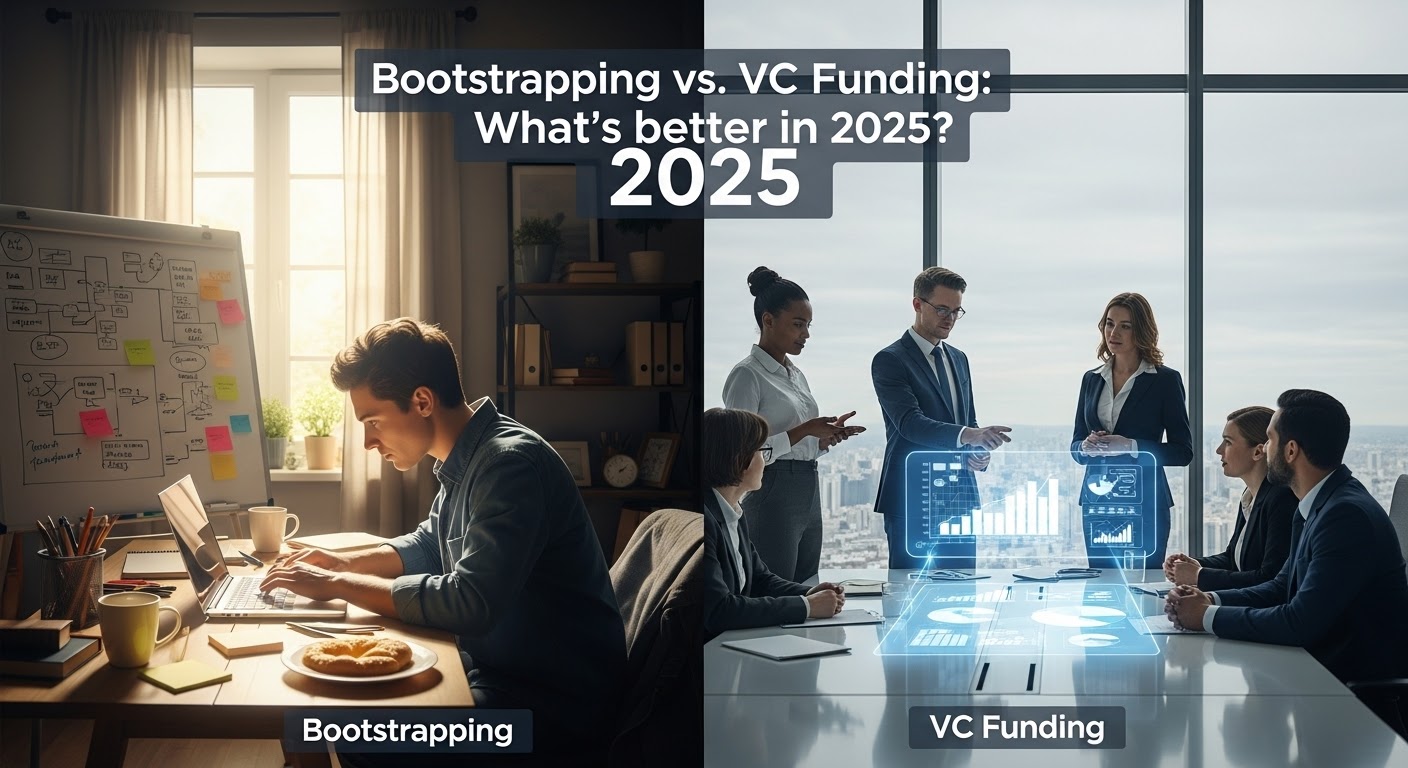
What Is Bootstrapping (2025 Edition)?
Bootstrapping means growing your startup without outside investment — using your own savings, early revenue, or customer-funded growth.
Thanks to modern tools, bootstrapping in 2025 is more powerful than ever:
-
AI tools can replace expensive teams (marketing, coding, customer support)
-
No-code platforms let non-developers build MVPs in days
-
Remote talent reduces hiring costs
-
Low-cost automation makes operations lean
It’s not uncommon now for a solo founder to build a profitable business that hits $1M+ ARR — all without a single investor.
Pros of Bootstrapping
-
Full ownership and control
-
Profit-focused from day one
-
No pressure to grow at unnatural speeds
-
Freedom to pivot without investor approval
Cons of Bootstrapping
-
Slower growth potential
-
Limited funds for product development, hiring, or marketing
-
Personal financial risk
-
More responsibility on the founder
What Is VC Funding (2025 Edition)?
Venture capital (VC) funding means receiving investment from external sources to scale your company quickly.
But the VC ecosystem in 2025 looks different:
-
Micro-VCs and niche funds are rising
-
Operator-led funds (run by ex-founders) are gaining influence
-
Global syndicates make fundraising more accessible worldwide
-
VCs are now valuing sustainability over “growth at all costs”
VC money gives founders the ability to scale fast, dominate markets, and compete aggressively — but comes with expectations.
Pros of VC Funding
-
Access to significant capital
-
Powerful networks, advisors, and talent pipelines
-
Ability to scale globally, quickly
-
Faster product development and R&D
Cons of VC Funding
-
Loss of control and equity dilution
-
Pressure to hit aggressive metrics
-
Expectation of an exit (IPO/acquisition)
-
Possible misalignment with your long-term vision
2025 Trends That Change the Game
1. AI Makes Bootstrapping More Accessible
Tasks that once required 10 employees can now be handled by automation, AI agents, and low-cost tools.
This narrows the gap between small and big companies.
2. VCs Are Prioritizing Sustainable Growth
After years of market correction, investors are finally favoring:
-
Profitability
-
Efficiency
-
Real customer demand
-
Path to breakeven
Hypergrowth isn’t dead — but it’s no longer the default.
3. Hybrid Funding Models Are Rising
Founders in 2025 have more options than just “bootstrap” or “raise VC.”
-
Revenue-based financing
-
Angel syndicates
-
Rolling funds
-
Community-backed investment
-
Grants and government programs
More flexibility = more founder-friendly paths.
4. Market Conditions Matter
Capital is still available, but not as freely as before.
Investors are more selective — which can make bootstrapping initially easier, but VC-funded scaling later harder.
So… Which Path Is Better in 2025?
There’s no universal answer.
It depends on who you are, what you’re building, and how fast you need to grow.
Choose Bootstrapping if:
-
You want control and independence
-
Your business can grow through revenue (SaaS, services, digital products)
-
You prefer sustainability over speed
-
You’re comfortable learning multiple roles (marketing, product, operations)
-
You’re building a lifestyle business or a lean, profitable company
Choose VC Funding if:
-
You’re building something that requires massive capital (biotech, hardware, AI infrastructure)
-
Speed and market dominance matter
-
You’re ready for aggressive growth targets
-
You want to hire a team quickly
-
You’re aiming for a large exit
Industry Breakdown
| Industry | Best Fit |
|---|---|
| SaaS / AI tools | Both, depending on speed & ambition |
| E-commerce | Bootstrap first, raise later |
| Deep tech / Biotech | VC funding necessary |
| Agencies / Services | Bootstrap |
| Marketplaces | Often VC (network effects) |
| Content or creator-led startups | Bootstrap |
Your Skillset Matters
Ask yourself:
-
Can you build or launch alone using AI/no-code tools?
-
Or do you need a full team to even get started?
Your answer may determine your path.
(Optional) Real Founder Examples
Bootstrapped Founder Success
A solo founder turned his AI productivity tool into a $1M ARR business in 14 months — with no office, no team, and no investors.
VC-Backed Founder Insight
“Scaling fast was incredible, but the pressure was real. Investors want results yesterday. Great for growth — but you must be ready.”
(If you want, I can add real names, stories, or quotes from known founders.)
Conclusion
There is no “better” option — only the option that aligns with your vision.
In 2025, founders win by being strategic, self-aware, and aligned with their long-term goals.
Whether you choose to bootstrap or raise capital, success comes from clarity:
-
What do you want?
-
How fast do you want to grow?
-
How much control do you want to keep?
-
What lifestyle or outcome are you working toward?
Are you building solo or raising capital? Comment your path below — I’d love to hear your strategy.
If you want, I can also create:
-
A downloadable checklist: “Should You Bootstrap or Raise?”
-
A LinkedIn-friendly carousel
-
A short-form caption for Instagram/TikTok
-
A pitch deck outline for raising VC